Subscribe to Our Blog

With RSS feeds, you don't have to visit our site everyday to keep up to date. Simply subscribe to our blog via RSS or Email and our posts will come to you!

Are Your Meal and Rest Break Policies Ready for January 1, 2026?

11.11.2025 Written by: Business Law Department

office workers take a lunch break

Effective January 1, 2026, meal and rest break law changes may require Employers to revise their Employee Handbooks. Under the current law, employers were required to provide employees with restroom time and time to eat a meal; however, the amount of time was left to the employer’s discretion. The only additional guidelines are that if the break was less than 20 minutes in duration, it must be counted as hours worked and paid. Any unpaid breaks require the employee to be completely relieved of work duties.

The amendments to the statute now mandate more specific requirements. Employers must provide at least a 15-minute rest break—or enough time to use the nearest convenient restroom, whichever is longer—within each four (4) consecutive hours worked. Additionally, employees working six (6) or more consecutive hours must receive a meal break of at least 30 minutes.

It is important to note that meal and rest break requirements fall under the Minnesota Fair Labor Standards Act (MFLSA), and not all workers meet the definition of “employee” under this law. The MFLSA definition excludes certain agricultural workers, individuals employed in bona fide executive, administrative, or professional capacities, and certain seasonal day camp staff members, to name a few.

With January 1, 2026, approaching quickly, it is important to ensure your employee policies comply with these new amendments. We encourage you to contact us to discuss how these changes affect your current policies and what updates may be necessary.

Read More


a jar with coins and a clock demonstrating saving for retirement.

The State of Minnesota enacted the Minnesota Secure Choice Retirement Program (the “Program”) in 2023, with an original launch date of January 1, 2025. While that deadline has passed, the Program’s new implementation date is now set for January 1, 2026.

Who Must Participate?

The Program requires Minnesota employers with five (5) or more employees to participate if they do not currently offer a qualified retirement plan. This requirement applies regardless of whether employees reside in Minnesota.

How the Program Works

The Program is structured as an employee-funded retirement savings initiative:

  • Contributions are deducted directly from employee paychecks and deposited into individual Roth IRA or traditional IRA accounts.
  • A Roth IRA will be automatically established for each employee unless they elect pre-tax contributions through a traditional IRA.
  • The proposed initial contribution rate is 5% of wages, with automatic annual increases of 1% until reaching a maximum of 8%.
  • Employees may opt out of participation at any time.

Employer Responsibilities

While employers cannot contribute to employee accounts under this Program, they do have specific obligations:

  • Facilitate payroll deductions and remit contributions to the Program’s service provider.
  • Bear administrative costs associated with processing and remitting contributions.
  • Provide Program information and enrollment materials to employees.
  • Note: There are no setup fees for establishing employee accounts.

Importantly, employers who do not offer a qualifying retirement plan cannot opt out of the Program once their compliance date arrives.

Implementation Timeline

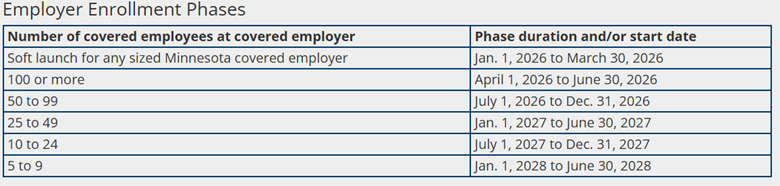
The Program features a phased rollout based on employer size. Employers should note they are not required to implement the Program until their designated compliance date:

https://securechoice.mn.gov/

Next Steps

Even if your compliance date is not immediate, we recommend familiarizing yourself with the Program requirements well in advance. This preparation ensures smooth implementation and gives you adequate time to communicate the new benefit to your employees.

For more information, visit the official Program website: https://securechoice.mn.gov/.

Please contact us with any questions regarding the Program. We will continue to provide updates as additional information becomes available.

Read More


One Big Beautiful Bill—One for the Businesses?
Blog Series: Part 3

10.30.2025 Written by: Business Law Department

A group of business people discuss OB3 investment and property provisions.

In our final installment of the One Big Beautiful Bill series, we turn to specialized investment and property provisions that could significantly impact specific types of business owners and investors. Part 3 explores three targeted provisions: enhanced benefits for small business stock investments, extended opportunity zone incentives, and new farmland sale options. While these provisions may not apply to every business owner, they offer substantial tax advantages for those who qualify.

1. Qualified Small Business Stock (“QSBS”)

QSBS is stock of a domestic C-corporation that has aggregate gross assets of less than $50 million when and immediately after the stock is issued. OB3 changed three key elements of QSBS: (1) shortened the required holding period from five to three years, with a phased-in exclusion amount for the holding period of between three to five years; (2) expanded QSB eligibility to C-corporations with gross assets not exceeding $75 million, adjusted annually for inflation; and (3) increased the flat cap, per issuer on the maximum amount of capital gain excludable from QSBS from $10 million to $15 million, adjusted annually for inflation.

2. Opportunity Zones (“OZ”)

OB3 permanently extends the OZ tax provisions of the Tax Cuts and Jobs Act (“TJCA”), which were set to expire at the end of 2026. Opportunity zones are designed to encourage people to invest in distressed areas to spur economic growth and job creation in low-income communities. A rolling 10-year OZ designation begins January 1, 2027. OB3 allows taxpayers to defer capital gains tax liabilities for five years from the date of investment, and they will receive a 10% exclusion of the original deferred gain. Among other things, OB3 also revised the OZ eligibility requirements and now includes enhanced tax incentives for investments in Qualified Rural Opportunity Zones. Investments in these rural OZ will receive a 30% exclusion of the original deferred capital gain after a 5-year holding period.

3. Sale of Farmland Property

For tax years beginning in 2026, OB3 allows taxpayers to elect to pay gain from the sale or exchange of qualified farmland to qualified farmers over four equal installments even if the total proceeds are received in a single tax year. Taxpayers can make this election by the due date of the initial tax return. Qualified farmland must be located in the United States and must have been used as a farm for the previous 10 years and must be subject to farm use restrictions for the next 10 years. Qualified farmers are individuals engaged in farming.

Conclusion

These specialized provisions in the One Big Beautiful Bill demonstrate Congress’s focus on supporting specific economic sectors through targeted tax incentives. From enhanced QSBS benefits that make small business investments more attractive to permanent opportunity zone extensions that encourage investment in underserved communities, these provisions create new planning opportunities for qualifying taxpayers. The farmland sale provision particularly benefits agricultural communities by providing installment payment options that can help manage tax burdens.

While these provisions may not apply broadly, they represent significant opportunities for those who qualify. However, these changes also come with compliance complexities and qualifying criteria that require careful navigation. As we conclude our three-part series on the One Big Beautiful Bill, we encourage you to work with your tax advisor to identify which provisions may benefit your specific situation and to develop strategies that maximize these new opportunities.

Our team at Henningson & Snoxell, Ltd. remains available to help you navigate these complex changes and optimize your business planning in light of OB3’s comprehensive reforms.

Read More


Minnesota Paid Family and Medical Leave—Employers’ Next Steps

10.28.2025 Written by: Business Law Department

A woman uses paid leave to take care of her elderly mother.

January 1, 2026, is approaching quickly, and employer obligations under Minnesota Paid Family and Medical Leave continue to ramp up. This new law requires employers to provide employees with access to up to 12 weeks of family leave and 12 weeks of medical leave per 52-week benefit year for qualifying events. However, employees can only utilize a capped 20 weeks if claiming under both family and medical leave.

Critical December Deadline

By December 1, 2025, employers must inform employees of their rights and benefits under Paid Leave through two required actions:

  1. Display the official Paid Leave poster in a conspicuous location in the workplace.
  2. Provide each employee with written notice of their new benefits.

The Minnesota Department of Employment and Economic Development (DEED) has prepared and made available both the required poster and a sample written notice to help employers comply.

Key Compliance Dates and Requirements

December 1, 2025 – Employee Notice Deadline

  • Inform all employees of their rights and benefits via the workplace poster and individual written notices.
  • Provide notices in English and in any other language that is the primary language of five (5) or more employees.
  • IMPORTANT: Employees hired after December 1, 2025, must receive individual notice within 30 days of their start date.
  • PENALTY WARNING: Failure to provide required notices may result in penalties of $50 per employee for a first violation and $300 per employee for subsequent violations.

January 1, 2026 – Paid Leave Program Launches

  • Benefits become available to eligible employees.
  • Employers may begin deducting the employee’s share of premiums from paychecks.

April 30, 2026 – First Premium Payment Due

  • Employers must remit the first quarterly premium payment.
  • This payment covers wages paid from January 1, 2026, through March 31, 2026.

We encourage you to reach out with any questions regarding Minnesota Paid Leave compliance. Our team is ready to help make this transition as seamless as possible for your organization.

Read More


One Big Beautiful Bill—One for the Businesses? Blog Series: Part 2

10.23.2025 Written by: Business Law Department

Businessman inspects his paperwork.

The One Big Beautiful Bill (“OB3”) takes a dual approach to business taxes: enhanced deductions for business investments paired with stricter limits on loss deductions. OB3 introduces expanded bonus depreciation and doubled Section 179 limits for equipment and property purchases, while also implementing permanent caps on excess business losses and modifying interest deduction calculations.

Part 2 of our blog series on OB3 focuses on business investment and loss limitation provisions:

1. Bonus Depreciation for Qualified Property

Bonus depreciation has been reinstated for certain new qualified property—including equipment, vehicles, and software—acquired after January 19, 2025. At the federal level, businesses may deduct up to 100% of the cost of qualifying property in the year of acquisition. However, Minnesota does not conform to this federal provision, so the full cost may not be deductible on your Minnesota return.

2. Expensing Limits under IRC Section 179

Section 179 allows businesses to expense personal property and certain qualified real property up to a set limit. OB3 increased the maximum deduction limit from $1 million to $2.5 million. Additionally, the phase-out threshold was increased from $2.5 million to $4 million. These limits will be adjusted for inflation. This applies to property placed in service in taxable years beginning after December 31, 2024.

3. Business Interest Deduction Limitation

IRC Section 163(j), beginning after January 1, 2022, limited interest deductions to 30% of taxable EBIT (Earnings Before Interest and Taxes) for certain businesses. OB3 modifies this limitation by reverting the calculation from Taxable EBIT back to taxable EBITDA (Earnings Before Interest, Taxes, Depreciation, and Amortization) for tax years beginning after December 31, 2024, which will allow more interest to be deducted. For tax years beginning after December 31, 2025, OB3 makes additional changes, including modifying the definition of interest included in the calculation. The revised provision will require taxpayers to include all interest, even capitalized amounts, in the total interest amount when determining the interest limit.

4. Excess Business Losses

The Tax Cuts and Jobs Act (“TCJA”) limited the deductibility of excess business losses for noncorporate taxpayers (including individuals who own a business, trusts, and estates), a limitation that was set to expire in 2028. OB3 made this limitation permanent. An excess business loss is the amount by which the total deductions attributable to all of a noncorporate taxpayer’s trades or businesses exceed their total gross income and gains attributable to those trades or businesses. In other words, if your business losses exceed your business profits by more than a certain limit ($626,000 for married filing jointly or $313,000 for singles in 2025), the excess loss beyond that limit is treated as excess business loss. Any disallowed losses carried over to the next tax year will be treated as net operating losses rather than excess business losses.

Conclusion

OB3’s business provisions create new opportunities for investment-focused deductions while establishing permanent limitations on business loss utilization. These changes will require business owners to adjust their tax planning strategies to navigate the updated depreciation benefits, Section 179 limits, and loss restriction rules as they plan for 2025 and beyond. However, these changes also come with compliance complexities and qualifying criteria that require careful navigation. We encourage you to meet with your CPA or tax advisor to discuss planning strategies that work best for your specific situation.

As always, Henningson & Snoxell, Ltd. is here to help! Contact us with questions about how OB3 impacts your business. Be sure to check back for our final installment of the One Big Beautiful Bill series, where we will wrap up the key takeaways and planning considerations.

Read More


One Big Beautiful Bill—One for the Businesses? Blog Series: Part 1

10.16.2025 Written by: Business Law Department

Business owner inspects her paperwork.

As you have likely heard, Congress and the Trump Administration signed into law the One Big Beautiful Bill Act (“OB3”) on July 4th, 2025, enacting a sweeping set of tax changes impacting individuals, estates, state, local, real estate, and business tax rules. While we know many of you have probably spent your first few weeks of fall reading all 330+ pages of the Act in your free time, we are launching this blog series to highlight a few key provisions that Minnesota business owners should know about.

Part 1 focuses on individual and pass-through provisions that affect business owners:

1. Qualified Business Income (“QBI”) Deduction

The QBI deduction was previously set to expire at the end of this year, potentially increasing taxes for many small-business owners. OB3 makes this deduction permanent. This means that eligible small businesses—structured as sole proprietorships, partnerships, S corporations, and LLCs—may continue to deduct up to 20% of their qualified business income.

2. Research and Development  (“R&D”) Expense Deductions

Under OB3, U.S.-based R&D expenses are now fully deductible in the year incurred, reversing the previous requirement to amortize these costs over five years. This change is retroactive, allowing businesses to amend prior tax returns and claim deductions they were previously unable to take.

3. New Deductions for Tips and Overtime

For tax years 2025 through 2028, individuals in tip-based industries—with specific industry definitions still pending—may qualify for deductions up to $12,500 in tip income for single taxpayers, subject to income phaseouts and the requirement that tips be voluntary. Additionally, taxpayers who receive qualified overtime compensation—also awaiting regulatory definition—may be eligible for a deduction on the overtime portion of their wages, though not the full time-and-a-half compensation required under the Fair Labor Standards Act (FLSA). These new deductions come with numerous qualifying criteria and limitations, so further guidance is expected.

4. Pass-Through Entity Tax (“PTET”)

PTET is a tax on pass-through entities (partnerships, LLCs, or S corporations) that allows these entities to elect to pay an entity-level tax in exchange for a credit or deduction of the state tax imposed on the owners of the entities. OB3 extended PTET and increased the limit on the State and Local Tax (SALT) deduction cap to $40,000 annually for married couples filing jointly up from the current $10,000 annual cap. The $40,000 limit will be adjusted for inflation beginning in 2026 and increase by 1% annually until 2030. In 2030, the SALT cap is set to revert to the $10,000 deduction amount.

Conclusion

OB3’s individual and pass-through provisions offer significant opportunities for business owners, from permanent QBI deductions to immediate R&D expense deductions and new tip and overtime deductions. However, these changes also come with compliance complexities and qualifying criteria that require careful navigation. We strongly encourage you to consult with your CPA or tax advisor to understand how these changes may impact your specific situation.

Our team at Henningson & Snoxell, Ltd. is ready to help you assess the impact, make strategic adjustments, and keep your business compliant and protected. Contact us to discuss how OB3 may affect your legal planning and operations. Stay tuned for Part 2 of our series, where we’ll explore the business-specific provisions of the One Big Beautiful Bill.

Read More


Minnesota Paid Leave: Equivalent Plans

07.18.2025 Written by: Henningson & Snoxell, Ltd.

Minnesota’s Paid Family and Medical Leave program launches in approximately six months. Employers now have approved alternatives to the state program, with the Minnesota Department of Employment and Economic Development (DEED) publishing its list of compliant private plans and self-insurance options.

Alternative Options to State Plan

Employers have two alternative options to utilizing the state program: self-insure or private insurance carrier plans. Regardless of your choice, you must provide paid family and medical leave that offers the same or better coverage to all employees, costs employees no more than the state program, and provides equal job protection.

Self-Insured Plans

Employers may choose to self-insure for paid family and medical leave, which means you manage paid leave requests and payments directly to employees. However, self-insured plans must be backed by a surety bond to ensure payment capability. The surety bond must be:

  • Issued by a surety company authorized to do business in Minnesota, and
  • Equal to your total annual premiums under the state plan.

To calculate the required bond amount, use the DEED Paid Leave calculator: https://mn.gov/deed/paidleave/employers/premiums/index.jsp

Insurance Carrier Plans (Private Plans)

The second option is enrolling in a private plan sold by an approved insurance carrier. DEED has published the list of approved carriers with compliant plans at: https://mn.gov/deed/assets/approved-equivalent-plans_tcm1045-695686.pdf

How to use the alternative plans?

You may choose either alternative at any time, but you must request an Equivalent Plan Substitution through DEED. The process involves setting up required accounts, submitting documentation, and paying a nonrefundable fee (between $250–$1000 depending on employer size).

Even with approved alternative plans, employers remain subject to certain state requirements. You must continue submitting wage detail reports to the state each quarter and comply with all employee notification requirements.

All employees must be informed of their rights and benefits under Paid Leave by December 1, 2025. These notices must be provided in employees’ native language, and workplace posters must be displayed in English and any language spoken by five or more employees. For employees hired after December 1, 2025, you must provide the required notice within 30 days of their start date. DEED will be providing a model notice for Employers to follow. Contact us with any questions regarding Minnesota Paid Leave.

Read More


Successful Representation in Breach of Fiduciary Duty Case

07.17.2025 Written by: Henningson & Snoxell, Ltd.

A book of estate planning law.

In a recent Wright County, Minnesota, case, Henningson & Snoxell, Ltd. attorneys, Mark V. Steffenson and Susan T. Peterson-Lerdahl, successfully represented a client who was short-changed in the distribution of her mother’s estate by her brother, the duly-appointed personal representative. The personal representative’s position was that the client’s distributive share of the estate should be reduced because the client still owed the decedent money under an old contract for deed arrangement between decedent and client. After a three-day evidentiary hearing, the court determined that the contract for deed carried contractual damages which had been satisfied when the client defaulted under the contract for deed and the property was sold and that the client should receive her equal distributive share of the estate. Further, the court held that the personal representative acted unfairly by reducing the client’s distributive share and that the personal representative breached his fiduciary duty by using undue influence over decedent in making codicils and by improperly administering the estate. The personal representative was removed for cause from service as personal representative.

As always, for any of your estate planning or elder law needs, feel free to contact one of Henningson & Snoxell, Ltd.’s estate planning and elder law attorneys: Susan T. Peterson-Lerdahl, Adam J. Kaufman, Eric J. Lilly, David T. Estle, and Rachell L. Henning.

Read More


Minnesota expands Rule Against Perpetuities to 500 years

07.08.2025 Written by: Henningson & Snoxell, Ltd.

Short History

Sometimes, statutes are written to satisfy both proponents and opponents of a law.  Minnesota’s Rule Against Perpetuities is a case in point.  A short history lesson best illustrates the concept.

In the late 1500s, the Duke of Norfolk created a trust to protect family property for his oldest son, who lacked capacity and was unable to own assets outright.  The Duke transferred all of his property to the trust and prohibited the trustee from selling any of it, thereby indefinitely removing the property from commerce.  This trust arrangement created controversy because some people did not believe that property should be encumbered with such restrictions that would last for generations.  After many years of litigation, the case was decided with the court issuing what is now known as the “rule against perpetuities”, which limited the amount of time that property could be held in trust to about 100 years.

As of August 1, 2025, Minnesota’s Rule Against Perpetuities (RAP) increases from 90 years to 500 years.  (Minnesota Statutes Section 501A.01(2025)).  Trusts created prior to August 1, 2025, will remain governed by the 90-year vesting rule.

How does the new law impact you?

 In general, a longer RAP period gives you more estate planning flexibility.  For example, you may wish to leave an inheritance to people who are not yet born (and who may never exist) or to make a gift…with certain legal conditions attached.  Or, you may want to plan to keep a property in the family for many generations.  Further, you may decide to use one or more trusts to plan to minimize or avoid estate tax at death.  If so, Minnesota’s new, longer, Rule Against Perpetuities will aid you in your planning. As always, for any of your estate planning or elder law needs, feel free to contact one of Henningson & Snoxell, Ltd.’s estate planning and elder law attorneys: Susan T. Peterson-Lerdahl, Adam J. Kaufman, Eric J. Lilly, David T. Estle, and Rachell L. Henning.

Read More


Simplifying Your Digital Estate

06.10.2025 Written by: Henningson & Snoxell, Ltd.

Senior couple uses legacy contact feature for their digital estate planning.

Apple’s “Legacy Contact” feature is a planning tool for your digital estate. When we make wills or other estate planning documents, we often focus on tangible assets like the car and fine china or on real property, such as the house. Today, some of our most invaluable assets are stored on our phones. Without proper planning, access to a loved one’s Apple account after his or her death is difficult, expensive, and time-consuming. If a person wishes to be proactive, Apple now offers the Legacy Contact feature as a planning tool. Keep reading to learn more.

Legacy Contact Feature

The Legacy Contact feature is a great alternative for individuals who prefer to avoid working through a court proceeding to gain access to a decedent’s iCloud account. Apple’s Legacy Contact allows an account holder to designate trusted people who are allowed to have access to his or her account data after his or her death.

Once the account holder is deceased, the designated contact person may go to Apple’s website and request access using the account holder’s death certificate and an access key, which is distributed to the Legacy Contact upon being delegated as such.

How to Appoint a Legacy Contact

An account holder can add up to five Legacy Contacts in his or her iPhone settings. To do so, first the account holder goes to Settings and taps his or her name at the top of the screen (otherwise known as Profile). Next, the account holder taps Sign In and Security, and then “Legacy Contact.” Once the account holder is at the Legacy Contact screen, he or she can scroll through his or her contact list and designate a contact as a Legacy Contact. Please note that each person selected must also be an iPhone holder (or at least have an Apple ID).

Once the account holder has designated a Legacy Contact, he or she will get a text with notice of the designation. That person can then access his or her account to find the access key: Settings, tap on your name > Sign in and Security > Legacy Contact.

How Does a Legacy Contact Gain Account Access?

If you are a Legacy Contact, you will need to request access to the decedent’s account through Apple.

First, go to Digital Legacy-Request access, tap or click on Request Access, and sign in with your Apple ID. After your identity is verified, you will need to upload the decedent account holder’s death certificate and enter your access key. Once Apple approves your request, you will receive an email containing a special Legacy Contact Apple account, which will be used to access the account holder’s data. From there, you will be able to access the account holder’s iCloud data for three years (from approval date).

What Data Can a Legacy Contact Access?

Privacy measures protect sensitive information, so signing into a Legacy Contact account is not the equivalent of logging into the account with the original account holder’s Apple ID username and password.

A Legacy Contact has access to:

  • iCloud photos
  • Notes
  • Mail
  • Contacts
  • Calendars
  • Reminders
  • Call history
  • Files stored in iCloud drive
  • iPhone Health app data
  • Voice memos
  • Safari bookmarks and reading list
  • iCloud messages

Legacy Contacts do not have access to:

  • Licensed media, such as books or music purchased on the phone
  • In-app purchases
  • Payment information, like credit card numbers or other Apple payment options
  • Information stored in the account holder’s keychain, such as usernames and passwords for websites and internet accounts, credit card numbers, or Wi-Fi passwords

We Can Help You Plan Ahead

If you or a loved one would like to pass on your digital legacy without subjecting your family to an expensive and time-consuming court proceeding, the Apple Legacy Contact feature may be the perfect solution for you.

As always, for any of your estate planning or elder law needs, feel free to contact one of Henningson & Snoxell, Ltd.’s estate planning and elder law attorneys: Susan T. Peterson-Lerdahl, Adam J. Kaufman, Eric J. Lilly, David T. Estle, and Rachell L. Henning.

Read More